
Color Vision and the Professional Pilot: What Career-Minded Pilots Need to Know
TLDR: Colorblind (or think you might be) and want to fly for a living?
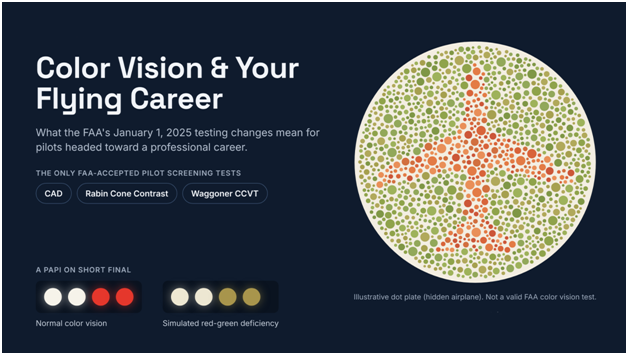 Get tested before you spend money on training. Take an FAA-approved computer-based color vision test, and ideally get your first-class medical, before you commit to a program.
- You only need to pass one of three tests. The approved tests are CAD, Rabin Cone Contrast, and Waggoner. There is no limit on attempts, so if you fail one, try another. Testing must be in person, and your AME needs the actual score report. Ishihara plates, the Farnsworth Lantern, and online tests no longer count.
- Failing all three has real career consequences. You get a third-class medical limited to day VFR only. That rules out airline and commercial flying for hire.
- There is still a path, but it isn’t guaranteed. Your AME can submit a Color Vision Limitation Review to the FAA. Operational testing is now case-by-case, not a routine second chance.
- Don’t count on workarounds. Color-correcting lenses (like X-Chrom) and practice apps don’t meet the standard.
- Already hold a third-class SODA or LOE? It’s protected, but upgrading to first or second class means retesting under the new rules.
- If you can’t clear the limitation, you can still stay in aviation. Options include daytime private flying, flight instruction, sport pilot (MOSAIC), gliders and balloons, drones, and non-pilot careers such as dispatch and maintenance. Air traffic control has its own color vision standard.
Every year, aspiring pilots walk into an aviation medical examiner’s office expecting a routine exam and walk out with a surprise: a medical certificate stamped “Valid for day visual flight rules (VFR) only.” For someone who simply wants to fly a Cessna on Saturday mornings, that limitation may be little more than an inconvenience. For someone who has already planned a path to the airlines, a corporate flight department, or a career as a professional instructor, it can feel like a door slamming shut.
Color vision deficiency is common. Roughly 8 percent of men and about half a percent of women of Northern European descent have some form of inherited red-green deficiency, which means that in any reasonably sized flight school, several students are likely to be affected. Many of them do not know it until they are tested. The good news is that color vision deficiency is not automatically the end of a flying career. The less comfortable news is that the FAA’s rules changed significantly on January 1, 2025, and some of the paths that pilots relied on for decades are no longer the routine options they once were.
If you are considering aviation as a career, this is an issue you want to understand before you spend tens of thousands of dollars on training, not after.
What the Regulations Actually Require
The color vision standard for all three classes of FAA medical certificate is found in 14 CFR Part 67 (sections 67.103, 67.203, and 67.303). The language is identical for first-, second-, and third-class medicals: the applicant must have the “ability to perceive those colors necessary for the safe performance of airman duties.”
That is a functional standard, not a diagnostic one. The regulation does not say a pilot must have perfect color vision. It says the pilot must be able to perceive the colors needed to do the job safely. The FAA describes that job as discerning cockpit displays, aircraft signaling, and airport lighting. Think about how much color matters in a modern airplane: red and green navigation lights that tell you which way another aircraft is moving, the white, red, and green of a VASI or PAPI, taxiway and runway edge lighting, colored airspace depictions on charts and moving maps, magenta and green course guidance on a glass panel, and the red, yellow, and green of weather radar and terrain displays. And of course, light gun signals from a control tower, which remain the backup method of communication if your radio fails.
Because the standard is the same for every class, the difference between classes is not in the color vision requirement itself. It is in what happens when an applicant does not pass screening, and in which pathways are available to remove a limitation.
Why Your Medical Class Matters for Your Career
Before digging into the testing changes, it helps to be clear about which medical certificate a career requires. Under 14 CFR 61.23:
- Airline captains exercising ATP privileges in Part 121 operations need a first-class medical, and in practice airlines expect every pilot they hire, first officers included, to hold and maintain a first-class medical.
- Commercial pilots flying for compensation or hire (charter, corporate, banner towing, aerial survey, agricultural work, pipeline patrol, and similar jobs) need at least a second-class medical.
- Private, recreational, and student pilots need a third-class medical (or BasicMed, where eligible).
- Flight instructors need at least a third-class medical only when acting as pilot in command; an instructor who is not acting as PIC does not need a medical at all.
This is the core career problem. Since January 1, 2025, an applicant who fails color vision screening and cannot get the limitation removed is issued a third-class medical with a day-VFR-only limitation. A third-class certificate does not support commercial flying for hire, and a day-VFR-only certificate is incompatible with almost every professional flying job that involves night or instrument operations, which is to say nearly all of them.
What Changed on January 1, 2025
For decades, color vision screening in the AME’s office usually meant a book of Ishihara or similar pseudoisochromatic plates: circles of colored dots with numbers hidden inside. If you failed the plates, you could try one of several alternative tests at another provider, such as the Farnsworth Lantern. If you failed those, you could request operational testing from the FAA. That multi-layered system gave color-deficient pilots several chances to demonstrate adequate color perception.
The FAA had several concerns with that approach. Printed plates fade over time, office lighting varies, and test sequences could be memorized. None of the common screening tests evaluated blue-yellow (tritan) deficiency. Cockpits have also become far more color-dependent, with multifunction displays and tablets carrying information that used to live on black-and-white gauges. The FAA has noted that military aircrew holding color vision waivers sometimes struggled with modern color-rich displays. Underlying all of this is the 2002 crash of FedEx Flight 1478 on approach to Tallahassee, in which the NTSB found that the first officer’s color vision deficiency, for which he held both military and FAA waivers, contributed to his misreading of the PAPI lights. The NTSB issued recommendations to the FAA afterward, and the agency cites them as part of the reason for modernizing.
The result is a new policy that took effect for all pilot medical exams performed on or after January 1, 2025. The key elements are:
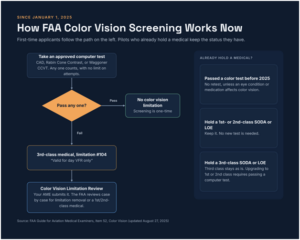
Only three tests are now accepted for pilots. All screening must be done on one of three FAA-approved computer-based tests:
- The City Occupational Colour Assessment and Diagnosis (CAD) test
- The Rabin Cone Contrast Test (RCCT), Air Force/Army/Navy/Coast Guard version
- The Waggoner Computerized Color Vision Test (CCVT)
Ishihara plates, the Farnsworth Lantern, the OPTEC 5000, yarn tests, and web-based or printed tests are no longer acceptable for pilot screening. Each approved test has its own FAA-published passing scores, and these tests screen for both red-green and blue-yellow deficiencies.
You need to pass only one. An applicant may take any or all of the three tests. Passing any one of them is a pass. Failing one does not stop you from trying another, and the FAA has said there is no limit on the number of attempts. Because the computerized tests present randomized images, memorization is not a factor, so repeated attempts are really a matter of getting comfortable with the testing format.
Testing must be in person and verifiable. Home tests, free-trial versions, and online apps do not count. You can be tested by an eye care provider or clinic that has one of the approved systems, but the AME must receive the actual computer-generated score report, and the testing provider’s identity and yours must be verifiable. A simple note saying “passed” is not enough.
Screening is now a one-time event. If you pass, you will not be retested at future exams unless you develop a condition or begin taking a medication associated with acquired color vision changes. The FAA lists examples such as glaucoma, cataracts, macular degeneration, diabetes, multiple sclerosis, and certain medications including hydroxychloroquine, some blood pressure drugs, and erectile dysfunction medications.
Existing pilots are largely grandfathered. A pilot whose most recent medical has no color vision limitation, meaning they previously passed an FAA-accepted test, does not need to retest. Pilots holding a first- or second-class Statement of Demonstrated Ability (SODA) or Letter of Evidence (LOE), earned by passing the older operational testing, keep that status. The FAA has stated that the new policy will not make an existing certificate more restrictive. You leave the AME’s office with the same status you walked in with unless you choose to take a new test.
Upgrades are where existing pilots get caught. A pilot holding a third-class SODA or LOE can continue to receive a third-class medical without a limitation. But if that pilot now wants a first- or second-class medical, perhaps because they have decided to pursue a professional career, they must take and pass one of the computer-based tests. If they fail, they receive a third-class medical with the day-VFR-only limitation, and the upgrade request goes to the Federal Air Surgeon for review.
Failure means a limited third class, not a deferral. If a new applicant fails all available tests and is otherwise qualified, the AME is instructed not to defer the exam. The AME issues a third-class medical with limitation #104: “Valid for day visual flight rules (VFR) only.” The same limitation applies if the AME does not have an approved test available, though in that case the applicant can be tested elsewhere and bring in the results.
The Old Path: OCVT and the Medical Flight Test
Many pilots and instructors still talk about the Operational Color Vision Test (OCVT) and the color vision Medical Flight Test (MFT) as if they are the standard next step after failing screening. For years, they were. The process looked like this:
- The OCVT was conducted by an FAA Aviation Safety Inspector, typically at an airport with a control tower. It included identifying light gun signals (red, green, and white, steady and flashing) at a distance, and reading and interpreting colors on aeronautical charts. Third-class applicants needed only the OCVT.
- The MFT was an actual flight with an FAA inspector, required for first- and second-class applicants, in which the pilot demonstrated the ability to identify and interpret colors inside and outside the aircraft: instruments and annunciators, airport lighting, other aircraft lighting, terrain features, and so on.
Passing both earned a Letter of Evidence that permanently documented the pilot’s ability, and the pilot received an unrestricted medical. Failing was a one-shot event that could leave a permanent limitation, so experienced pilots often warned students to prepare carefully and to treat the test with the seriousness of a checkride.
Under the 2025 policy, the computer-based tests are the standard pathway, and the OCVT and MFT are no longer the routine “second chance” that applicants can simply request after failing screening. Pilots who already earned an LOE or SODA through operational testing keep it. For everyone else, the route to removing a limitation or upgrading to a first- or second-class medical after failing the computer tests is a Color Vision Limitation Review.
The Color Vision Limitation Review: Today’s Version of a Special Evaluation
The Color Vision Limitation Review is an FAA form your AME completes and uploads, along with the score reports from your color vision tests. It is used when a pilot cannot pass any acceptable computer-based test and wants a first- or second-class certificate, when a pilot wants a color vision limitation removed, or when a pilot holding a third-class SODA or LOE wants to upgrade. Pilots holding older limitations, such as “Not valid for flights requiring color signal control” or “Not valid for night flying or by color signal control,” can also use it.
The FAA states that these requests are reviewed case by case and that additional information may be required. In practice, this is the doorway through which a pilot may be offered an opportunity to demonstrate ability, including operational evaluation, at the FAA’s discretion. Industry aeromedical sources describe operational testing as something the FAA now considers only on a case-by-case basis rather than as a routine right. That is a meaningful change, and it is why I encourage pilots not to assume that a practical demonstration will be offered.
If you do end up with that opportunity, prepare for it the way you would for any practical test. Know the light gun signals cold. Practice identifying airport lighting, navigation lights, and chart colors with a color-normal pilot or instructor who can tell you honestly what you are and are not seeing. Fly at dusk and at night with an instructor, so that you are evaluating your perception under the lighting conditions that actually challenge color-deficient pilots. Understand your own deficiency well enough to know which color pairs give you trouble, and develop backup cues, such as position, sequence, and flashing patterns, that do not depend on hue alone. An honest self-assessment here is also a safety issue; the goal is not to beat a test but to be sure you can safely do the job.
What Does Not Work
One question I hear frequently is whether color-correcting glasses or contact lenses can help. They cannot, at least not for FAA purposes. The FAA explicitly does not accept color-correcting lenses such as X-Chrom, and tinted products marketed to enhance color perception are not an accepted method of meeting the standard. Taking a test while wearing such lenses is not permitted, and flying with them does not address the underlying deficiency.
Similarly, practicing with online plate tests or apps may help you get familiar with the idea of color testing, but those results are not accepted, and the computerized tests are designed so that memorization does not help.
Practical Advice for Career-Minded Pilots
If you are thinking about aviation as a career, here is what I would do:
Get tested before you invest. Do not let your first color vision test be the one at your first-class medical exam after you have spent a year and a large sum on training. Find an AME or eye care provider who has one of the approved computer tests and get evaluated early. Ideally, get your first-class medical before you begin flight training at all. Many flight schools and university programs already recommend this, and color vision is a big reason why.
Try more than one test if you fail. The three tests measure color vision differently, and some pilots who struggle with one pass another. You need to pass only one, and there is no limit on attempts. If your AME has only the Waggoner test, ask about referral to a provider who has the Rabin or CAD test.
Bring documentation. If you test somewhere other than your AME’s office, make sure you leave with the actual computer-generated score report and that the provider’s information is on it. If you were tested with an approved test in the military, those results may be submitted.
If you already hold a third-class SODA or LOE, think before you upgrade. Your current status is protected for third class. Seeking a first- or second-class medical will require new testing under the current rules, so understand the possible outcome and talk with a knowledgeable AME before you apply.
Be honest on the application. The new system is designed to be more objective and harder to game. A medical certificate obtained through inaccurate information can be far more damaging to a career than a limitation ever would be.
Flying Options with a Day-VFR-Only Limitation
Even if a pilot cannot get the limitation removed, there are still ways to fly, and in some cases to earn a living in or around aviation. Always confirm the current regulations and your individual situation with your AME and an aviation attorney or aeromedical consultant when necessary, but here are options worth exploring.
Private flying during the day. A third-class medical with limitation #104 still allows you to earn and use a private pilot certificate for daytime VFR flight. For many people, that is the majority of the flying they would ever do anyway.
Flight instruction. This is one of the most interesting options. A flight instructor who is acting as pilot in command needs only a third-class medical, and an instructor not acting as PIC needs none. A pilot who earns a commercial pilot certificate and a flight instructor certificate can provide paid flight instruction under a day-VFR-limited third-class medical, within the limits of that certificate. There are real constraints. You cannot give night instruction or fly in instrument conditions while acting as PIC, which limits what you can teach, and you cannot exercise commercial pilot privileges such as charter or other flying for hire with only a third-class medical. But daytime primary instruction, flight reviews, and ground instruction are legitimate professional work.
Sport pilot under MOSAIC. The FAA’s MOSAIC rule, whose pilot provisions took effect on October 22, 2025, significantly expanded sport pilot privileges and the range of aircraft sport pilots can fly. Sport pilots may fly during the day using a valid U.S. driver’s license in place of an FAA medical, provided they meet the rule’s conditions, including that their most recent application for an FAA medical was not denied and their certificate has not been suspended or revoked. A medical issued with a limitation is not a denial, but if you are considering this route, confirm your eligibility. Note that MOSAIC’s new night privileges for sport pilots require an FAA medical certificate or BasicMed, so a driver’s license alone does not open night flying. Sport pilot flight instructors also operate under the sport pilot medical provisions, which creates a path to daytime instruction in light-sport category aircraft.
Gliders and balloons. Pilots exercising privileges in gliders and balloons are not required to hold an FAA medical certificate. Commercial pilot certificates are available in both categories, and commercial glider and balloon pilots can carry passengers for hire and provide instruction, typically during daylight when these operations naturally take place. Glider ride operations, glider towing for soaring clubs, and commercial balloon ride businesses are small but real corners of the industry.
Drones. Remote pilots operating under Part 107 do not need an FAA medical certificate. Commercial drone work in inspection, mapping, agriculture, public safety, and media is a growing field that values aeronautical knowledge.
Careers around the cockpit. Aircraft dispatchers, maintenance technicians, aviation safety and training professionals, and ground instructors all build careers in aviation without needing a pilot medical certificate. Air traffic control is another matter: controllers must meet a separate color vision standard, and the FAA has not changed those requirements, so color deficiency can be disqualifying there as well.

The Bottom Line
The 2025 changes made color vision testing more objective, more consistent, and, for most pilots with normal color vision, simpler. If you pass once, you are done. For pilots with color vision deficiency, the changes eliminated many of the alternative tests and made operational testing a discretionary step rather than a routine one. That raises the stakes for anyone who wants to fly professionally.
The single most important thing a career-minded pilot can do is find out early. Take an approved computer-based test, and if possible earn a first-class medical, before committing to a training program. If you pass, you can move forward with confidence. If you do not, you will have the information you need to try other approved tests, pursue a Color Vision Limitation Review, or make an informed decision about which kinds of flying, and which aviation careers, still fit your goals. There are still plenty of ways to stay involved in aviation, and knowing where you stand is the first step toward choosing the right one.
This article reflects FAA policy as published in the Guide for Aviation Medical Examiners and related FAA color vision guidance current as of November 2026. Aeromedical policy changes; confirm current requirements with your AME and the FAA before making training or career decisions.
Comments
Color Vision and the Professional Pilot: What Career-Minded Pilots Need to Know — No Comments
HTML tags allowed in your comment: <a href="" title=""> <abbr title=""> <acronym title=""> <b> <blockquote cite=""> <cite> <code> <del datetime=""> <em> <i> <q cite=""> <s> <strike> <strong>